
Microsoft’s $9.7 Billion Deal Signals Shift from Bitcoin Mining to AI Hosting

Overview of Microsoft’s Strategic Investment
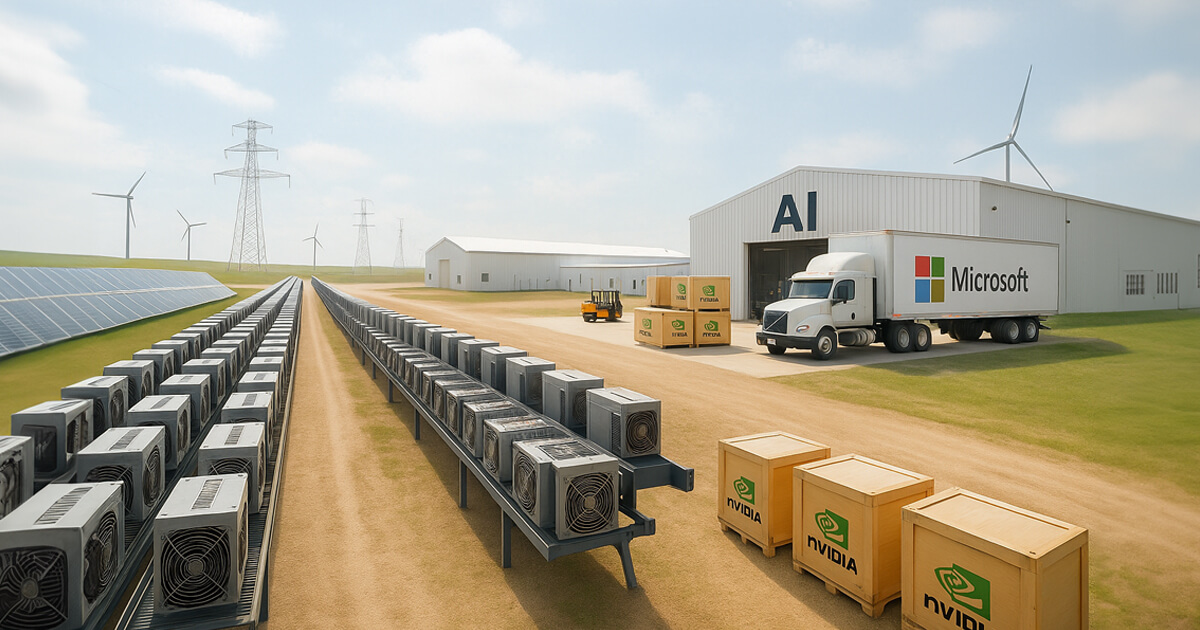
In a groundbreaking move, Microsoft has inked a massive $9.7 billion contract with the Texas-based cryptocurrency mining company, IREN. This partnership indicates a significant shift in the market of cryptocurrency infrastructure as it transitions towards artificial intelligence (AI) capabilities. The deal combines two separate transactions: a five-year cloud services agreement with Microsoft and a $5.8 billion equipment procurement deal with Dell for Nvidia’s latest GB300 systems. This shift is expected to have far-reaching implications for existing cryptocurrency networks.
The Details of the Deal

IREN’s announcement on November 3 marks a key point in its strategy. The total commitment of around $15.5 billion will transform about 200 megawatts of its IT capacity in Childress, Texas. Instead of focusing on Bitcoin mining, this capacity will now support GPU hosting for Microsoft’s AI workloads. IREN aims to increase its AI capacity from 75 megawatts in late 2025 to 200 megawatts by mid-2026, clearly responding to the rising demand for AI capabilities.
Financial Implications
The deal features a significant upfront payment of around $1.9 billion, representing 20% of the total contract value. This prepayment underscores the urgency of addressing capacity constraints, a concern raised by Microsoft’s CFO that’s expected to persist at least until mid-2026. The financial mathematics behind this transition reveals that every megawatt allocated to AI hosting yields approximately $500,000 to $600,000 more in annual gross revenue compared to Bitcoin mining. This substantial margin is driving a shift in how infrastructure is utilized within the cryptocurrency domain.
Understanding Revenue Dynamics
Currently, Bitcoin mining operates at an efficiency of 20 joules per terahash, generating about $0.79 million per megawatt-hour based on a hash price of $43.34 per petahash daily. If the hash price reaches $55, mining revenue would only climb to $1 million per megawatt-year. On the other hand, AI hosting is producing revenue around $1.45 million per megawatt-year, based on contracts disclosed by Core Scientific with CoreWeave. Over a timeline of 12 years, this translates to approximately $8.7 billion in cumulative revenue from around 500 megawatts.
Market Conditions for Bitcoin Mining
In contrast, for Bitcoin mining to match the economics of AI hosting, the hash price would need to rise significantly—between $60 and $70 per petahash per day. This substantial increase would require either a sharp rise in Bitcoin prices or a significant downturn in network hashrate, scenarios that are unpredictable and not guaranteed for operators. The financial pressure on Bitcoin miners is palpable, especially as their gross margins begin to dwindle when power costs hit about $50 per megawatt-hour. (CoinDesk)
The Strategic Advantage of Texas
One of the reasons behind IREN’s pivot is the advantageous position of its Childress campus within the ERCOT grid. Power prices in Texas are generally lower, averaging between $27 to $34 per megawatt-hour, compared to the national average nearing $40. This cost efficiency is partly due to the rapid expansion of solar and wind energy, which helps stabilize power costs. You might also enjoy our guide on Samsung Semiconductor Recovery: Analyzing 2025’s Remarkable .
Flexibility in Operations
Another benefit of the Texas location is the ERCOT’s energy-only market structure. This environment allows for rapid adjustments to operations based on market demands, which can be a breakthrough for both Bitcoin mining and AI hosting. For example, Riot Platforms recently capitalized on this model by earning $31.7 million in demand response credits by reducing its mining activities during peak pricing periods. AI hosting can similarly adapt, allowing operators to halt operations during extreme price spikes and resume when conditions normalize.
What’s Next for Miners?
IREN’s plans include deploying a 75-megawatt, liquid-cooled installation specifically designed for modern GPUs by the second half of 2025, with further expansions planned. This timeline aligns neatly with Microsoft’s looming capacity issues, suggesting that third-party AI hosting services will become increasingly valuable even as larger hyperscale builds come online.
Impact on Bitcoin Mining Network
As companies like IREN shift their operations from Bitcoin mining to AI hosting, the overall hashrate growth in Bitcoin mining could slow down. The network has recently surpassed one zettahash per second, but if a significant amount of capacity is repurposed, the remaining miners may enjoy slightly increased earnings per petahash mined. This change will also benefit those miners using high-efficiency fleets.
Linking Financial Performance to AI Operations

Miners transitioning to hosting contracts will find their revenue structures becoming more reliable. Core Scientific’s agreements with CoreWeave demonstrate how de-linking from Bitcoin’s volatile spot market can stabilize cash flow. IREN’s contract with Microsoft achieves a similar outcome, allowing the company to focus on operational efficiency instead of fluctuating Bitcoin prices.
Long-Term Effects on Bitcoin’s Market
This strategic shift could also have broader implications on Bitcoin’s supply-demand dynamics. As miners reduce their output to focus on more stable hosting contracts, there might be less selling pressure in the market. This decrease could marginally tighten the balance between Bitcoin’s supply and demand, especially if such trends spread throughout the industry. For more tips, check out OpenAI’s gpt-realtime: Transforming Voice AI for Enterprises.
Risks and Future Considerations
Of course, not everything is certain. If Bitcoin prices rise sharply while the hashrate growth stagnates due to the industry’s pivot, the hash price could potentially exceed $60 per petahash per day, bringing Bitcoin mining back into a competitive position against AI hosting economics. However, miners locked into long-term contracts may find themselves unable to pivot back, as they would already have committed to their new hardware and operational frameworks. (Bitcoin.org)
Conclusion: A New Era in Cryptocurrency Infrastructure
Microsoft’s partnership with IREN represents a significant turning point in the cryptocurrency world. This strategic move away from Bitcoin mining towards AI hosting illustrates the evolving nature of the industry and its adaptability to market conditions. As we witness this transition unfold, it will be fascinating to see how other miners respond and whether similar strategies emerge across the board.
FAQs
what’s the significance of Microsoft’s deal with IREN?
This deal highlights a major shift from Bitcoin mining to AI hosting, indicating changing priorities in the cryptocurrency infrastructure world.
How much power will IREN’s Childress campus provide for AI workloads?
IREN plans to scale its AI capacity to 200 megawatts by mid-2026.
Why are companies shifting from Bitcoin mining to AI hosting?
AI hosting provides significantly higher revenue potential compared to Bitcoin mining, which has faced declining profitability.
What economic factors influence the profitability of Bitcoin mining?
Mining profitability is affected by Bitcoin prices, power costs, and network difficulty, making it volatile and unpredictable.
Can miners return to Bitcoin mining after transitioning to AI hosting?
Once miners enter long-term AI hosting contracts, it’s challenging to revert back since they commit to specific hardware and operational designs.
Similar Articles
You Might Also Like


