
Introducing FunctionGemma: Google AI’s Edge-Optimized Function Calling Model

what’s FunctionGemma?
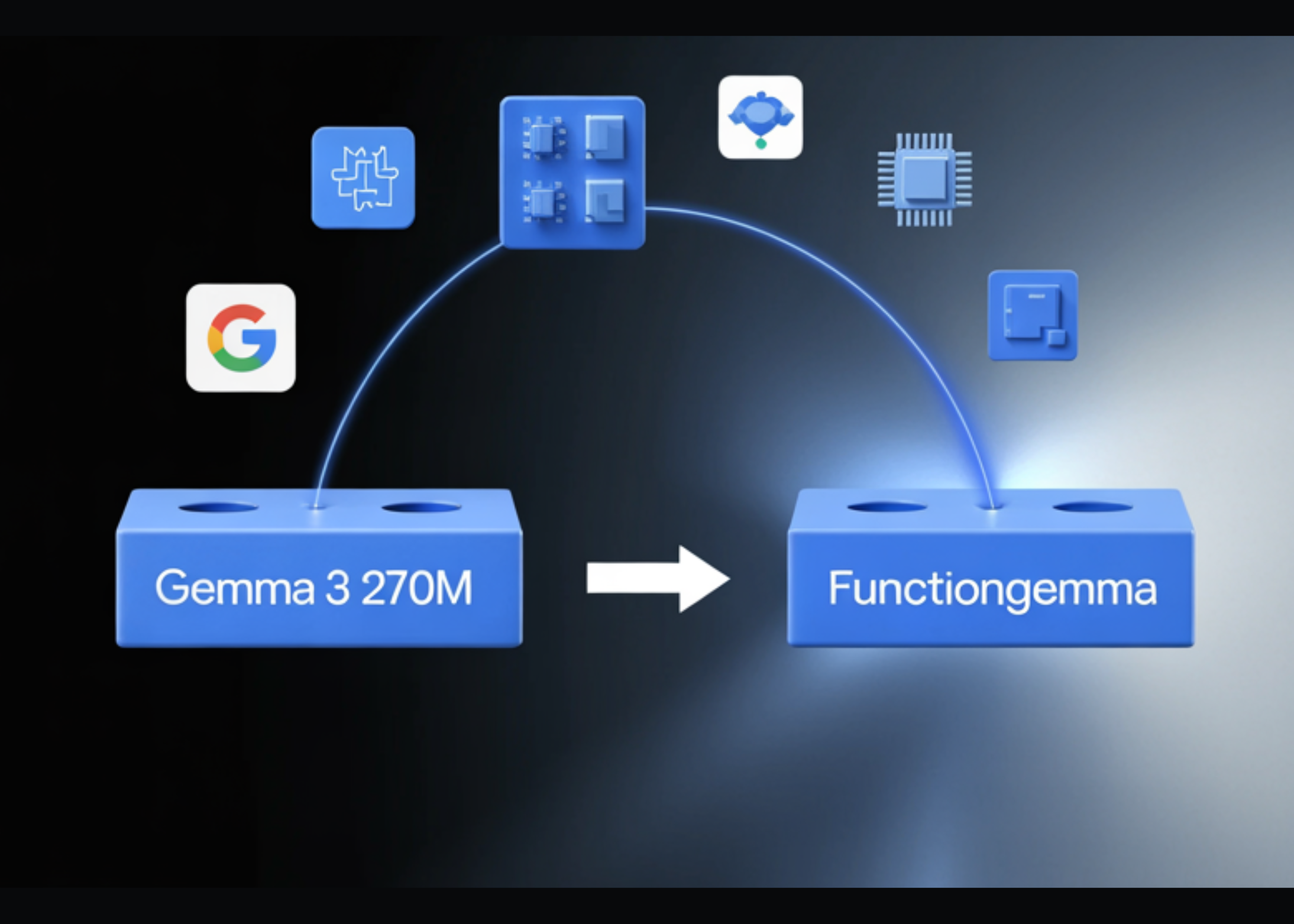
FunctionGemma is an advanced AI model developed by Google, specifically designed for function calling tasks. It’s a compact 270 million parameter transformer rooted in the Gemma 3 framework, but tailored to translate natural language into executable API actions efficiently. Unlike its predecessor, it’s not meant for open-ended chats but focuses on creating structured function calls based on user instructions. This specialized design allows FunctionGemma to excel in scenarios where precise command execution is critical, making it a key tool for developers seeking to harness AI capabilities in their applications.
Understanding the Architecture and Training

Architecture Details
This model maintains the same architecture as Gemma 3, using a JAX-powered backend on large TPU clusters, ensuring it operates effectively in edge environments. The vocabulary is designed to support JSON structures and multilingual text, which enhances its efficiency in processing function schemas and tool responses. On top of that, the architecture’s adaptability allows it to integrate with various API systems smoothly, broadening its usability across different platforms and services. This flexibility is critical for developers who need to implement AI-driven functionalities without extensive overhead.
Training Dataset and Objectives
FunctionGemma was trained on a staggering 6 trillion tokens, emphasizing two main areas: public tool definitions and interactions involving function calls. This in-depth dataset enables the model to learn both the syntax required for function calls and the intent behind user queries, ensuring it knows when to execute a function and when to seek further clarification. The extensive training not only covers a wide array of functions but also incorporates diverse use cases, allowing the model to be versatile in handling real-world scenarios. This depth of training supports FunctionGemma’s ability to adapt to various user needs and preferences, enhancing overall user satisfaction.
Interaction and Control Mechanics
Conversation Format
Unlike conventional chatbots, FunctionGemma uses a structured conversation format. Users interact with it through a predefined template that clearly outlines roles (like developer, user, or model) and tool-related areas within the conversation. Each turn of dialogue is marked distinctly, ensuring clarity in interactions. This structured format not only improves user experience by reducing misunderstandings but also aids in debugging and testing, as developers can easily track the flow of conversation and functions invoked. Clarity in structure enhances the model’s reliability and effectiveness in various applications. (CoinDesk)
Control Tokens
FunctionGemma employs a fixed set of control tokens to delineate different aspects of conversation. Tokens such as <start_function_declaration> and <end_function_declaration> help define tool functionalities, while tokens for function calls and responses maintain order in the conversation. This structured approach is key for reliable performance in production settings. By using control tokens, developers can also customize interactions more effectively, allowing for tailored responses that meet specific application requirements. This customization potential makes FunctionGemma an attractive option for businesses looking to integrate AI into their services.
Performance and Fine-Tuning
The base version of FunctionGemma showcases admirable performance out of the box, achieving 58% accuracy on initial testing. However, its true potential is realized through fine-tuning for specific tasks. For instance, after applying domain-specific adjustments, accuracy can soar to 85%. This fine-tuning process not only boosts performance but also allows the model to specialize in niche applications, making it highly effective for targeted use cases. Developers can take advantage of this capability to create solutions that address unique challenges in their respective industries, maximizing the utility of the AI model. You might also enjoy our guide on Cryptocurrency Developments in East Asia: A Weekly Overview.
Real-World Applications
FunctionGemma is particularly suited for edge deployments, functioning effectively on devices like smartphones and laptops. Its low memory footprint and latency requirements make it a great fit for consumer hardware, and Google provides several reference applications to demonstrate its capabilities. These applications showcase how FunctionGemma can enhance everyday tasks, providing users with more efficient ways to interact with their devices. The model’s ability to operate easily across various hardware is a testament to its design and training, empowering developers to build applications that are both powerful and accessible.
Innovative Demos and Use Cases
Mobile Actions
One of the standout applications is Mobile Actions, which serves as an offline assistant for controlling device functions. By building on the trained model, users can execute commands like creating calendar events or toggling flashlight settings with ease. This capability not only simplifies user interactions but also enhances the functionality of mobile devices, allowing for a more intuitive user experience. The ability to perform tasks offline further adds to its appeal, catering to users in areas with limited connectivity.

Tiny Garden
This voice-controlled game uses FunctionGemma to break down user commands into functional actions, such as planting seeds and watering plants, allowing for an interactive gaming experience. The engaging nature of the game showcases the model’s ability to process and respond to user input in real-time, making it an entertaining way to demonstrate the technology. As players interact with Tiny Garden, they experience firsthand the efficiency and responsiveness of FunctionGemma, reinforcing its potential for creating engaging applications.
Physics Playground
Running entirely in-browser, this demo enables users to solve physics puzzles by giving natural language instructions. FunctionGemma efficiently translates these into actionable simulation tasks. This capability not only highlights the model’s versatility but also emphasizes its potential for educational applications, where interactive learning can significantly enhance the user experience. By providing a platform for users to explore complex concepts through natural language, Physics Playground positions FunctionGemma as a valuable tool in both academic and casual learning environments. For more tips, check out Grayscale: Pioneering Crypto Staking on Wall Street.
Conclusion
In summary, FunctionGemma represents a significant advancement in AI function calling technology. With its powerful architecture, extensive training, and tailored applications, it’s positioned to become a valuable asset for edge computing environments. Whether you’re looking to build interactive applications or enhance user experiences, FunctionGemma offers a powerful solution. Its innovative design and performance metrics suggest a promising future for AI in function execution, paving the way for more intelligent and user-friendly applications across various domains. (Bitcoin.org)
FAQs
what’s the main purpose of FunctionGemma?
FunctionGemma is designed to convert natural language into structured API function calls, focusing on efficiency and accuracy in edge computing environments.
How does FunctionGemma differ from traditional AI chatbots?
Unlike traditional chatbots that engage in free-form dialogue, FunctionGemma uses a structured conversation format specifically for executing functions based on user commands. This approach allows it to handle tasks with precision and clarity, making it more suitable for applications requiring specific outputs.
What improvements can be achieved through fine-tuning?
Fine-tuning FunctionGemma for specific tasks can significantly enhance its accuracy, increasing from 58% to 85% on specialized datasets. This improvement highlights the model’s adaptability and effectiveness in diverse scenarios, enabling it to fulfill various user needs more accurately.
What types of devices can run FunctionGemma?
FunctionGemma is optimized for devices with limited resources, including smartphones, laptops, and small accelerators like NVIDIA Jetson Nano. Its lightweight design ensures that it can perform well even on hardware with constrained capabilities, making advanced AI accessible to a broader audience.
Where can I learn more about FunctionGemma?
You can find more technical details on FunctionGemma on the Hugging Face website and stay updated by following Google AI on Twitter. Engaging with these resources will provide deeper insights into its functionalities and applications, as well as keep you informed about future developments in this exciting field.
Related Reading: Introducing Kimi K2.5: The Revolutionary Open Source AI Model, Google DeepMind Unveils AlphaGenome: A Unified Sequence-to-Function Model Using Hybrid Transformers and U-Nets to Decode the Human Genome
You Might Also Like


