
Introducing Google’s LiteRT NeuroPilot: A Game Changer for On-Device AI Models
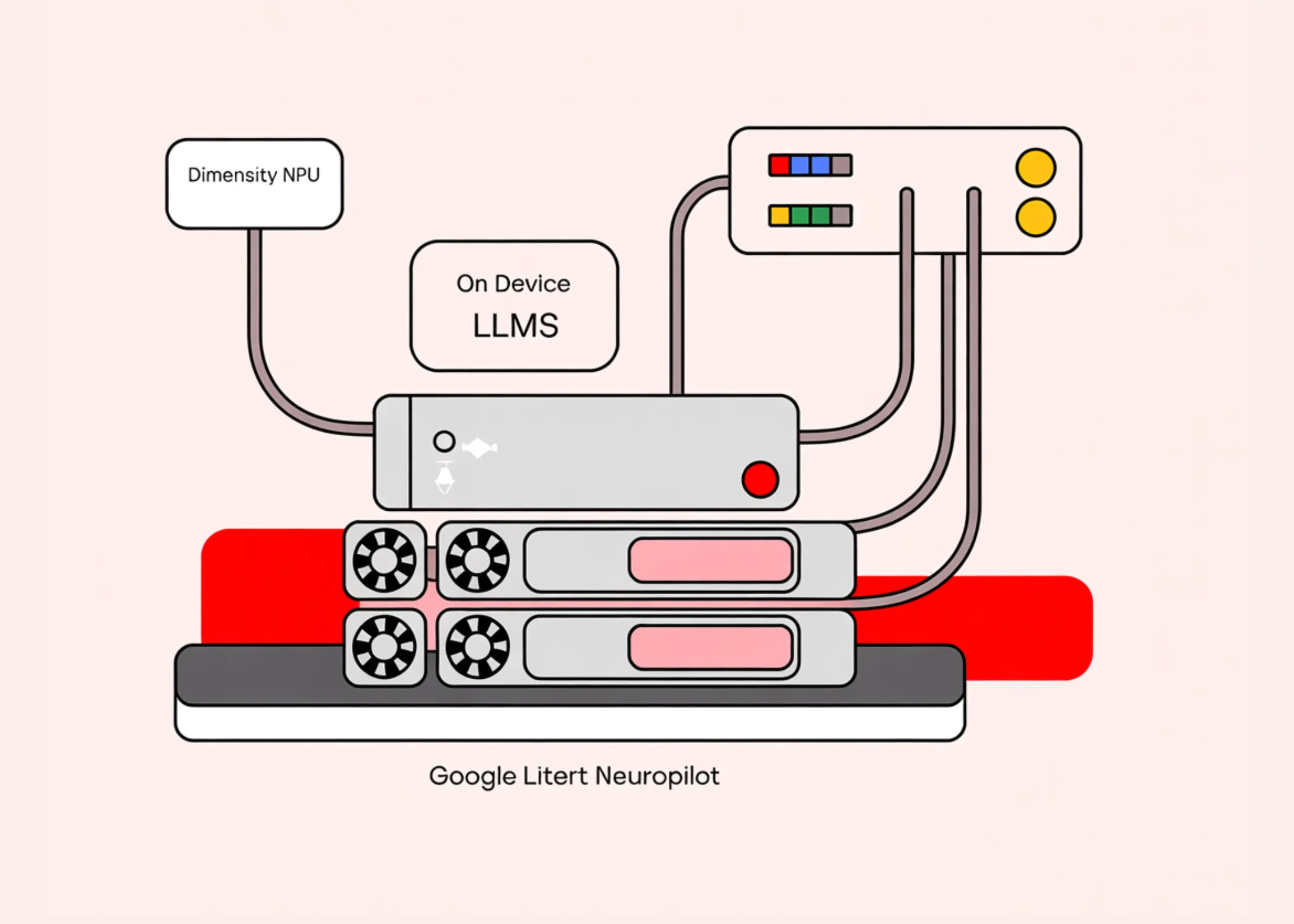

Overview of Google’s LiteRT NeuroPilot Accelerator
The LiteRT NeuroPilot Accelerator from Google and MediaTek is a groundbreaking step forward in the world of on-device artificial intelligence. This new technology allows generative models to run directly on smartphones, laptops, and IoT devices without the need to constantly connect to a data center. By integrating the LiteRT runtime with MediaTek’s NeuroPilot Neural Processing Units (NPUs), developers can now deploy large language models (LLMs) and embedding models through a single API rather than writing custom code for each chip.
what’s LiteRT NeuroPilot?

LiteRT is the successor to TensorFlow Lite, offering high-performance runtime capabilities right on the device. It efficiently runs models in the .tflite FlatBuffer format and can build on various hardware acceleration layers, including CPU, GPU, and now NPUs.
The Role of LiteRT NeuroPilot Accelerator
As a new path for MediaTek hardware, the LiteRT NeuroPilot Accelerator replaces the outdated TFLite NeuroPilot delegate, paving the way for a more integrated experience. By directly connecting to the NeuroPilot compiler and runtime, LiteRT enhances the development process. Instead of treating the NPU as a mere delegate, it introduces a Compiled Model API that accommodates both Ahead of Time (AOT) compilation and on-device compilation, all accessible through familiar C++ and Kotlin APIs.
Why is This Important for Developers?
For developers, the introduction of a unified workflow is a significant improvement over the historically fragmented NPUs. Previously, on-device machine learning stacks primarily utilized CPU and GPU first approaches. NPU SDKs typically required separate toolchains and complex compilation processes for each System on Chip (SoC), which often resulted in a tangled mess of binaries and debugging challenges.
Simplified Three-Step Workflow
With LiteRT NeuroPilot Accelerator, the development process is streamlined into three straightforward steps:
- Convert or load a .tflite model as you normally would.
- Work with the LiteRT Python tools, if desired, to run AOT compilation and create an AI Pack tailored for specific target SoCs.
- Distribute the AI Pack via Play for On-device AI (PODAI) and select Accelerator.NPU at runtime. LiteRT efficiently manages device targeting and runtime loading, falling back to GPU or CPU when necessary.

This change means that device targeting logic is now centralized in a configuration file and Play delivery system, simplifying how engineers interact with CompiledModel and Accelerator.NPU. You might also enjoy our guide on OpenAI debuts GPT‑5.1-Codex-Max coding model and it already .
AOT vs. On-Device Compilation
Both AOT and on-device compilation options are supported. AOT compilation is beneficial for larger models, as it compiles ahead of time for a specific SoC, saving time during user device execution. In contrast, on-device compilation is suitable for smaller models and more generic .tflite distributions but may lead to longer initial latency. For instance, compiling the Gemma-3-270M model on-device could take over a minute, making AOT the preferable choice for production-level LLM applications. (CoinDesk)
Supported Models on MediaTek NPUs
The LiteRT NeuroPilot Accelerator is designed to work with a range of open weight models rather than relying on a single proprietary Natural Language Understanding (NLU) solution. Some supported models include:
- Qwen3 0.6B: Optimized for text generation in markets like mainland China.
- Gemma-3-270M: A compact model ideal for tasks such as sentiment analysis and entity extraction.
- Gemma-3-1B: A multilingual model focused on summarization and general reasoning.
- Gemma-3n E2B: A multimodal model that processes text, audio, and vision for applications like real-time translation and visual question answering.
- EmbeddingGemma 300M: A model geared towards retrieval-augmented generation, semantic search, and classification.
On the MediaTek Dimensity 9500, the Gemma 3n E2B variant can process over 1600 tokens per second during prefill and 28 tokens per second during decoding with a 4K context length, showcasing impressive performance on NPUs.
C++ Developer Experience
The introduction of new C++ APIs replaces older entry points with a structure that includes explicit Environment, Model, CompiledModel, and TensorBuffer objects. This enhancement enables painless integration with Android’s AHardwareBuffer and GPU buffers. Developers can directly create input TensorBuffer instances from OpenGL or OpenCL buffers, allowing image processing tasks to use NPU inputs without unnecessary data copies through CPU memory. This is particularly vital for real-time video and camera processing, where memory bandwidth can quickly become a bottleneck.
A Simplified C++ Workflow
A basic high-level C++ workflow would look like this:
// Load model compiled for NPU
auto model = Model::CreateFromFile("model.tflite");
auto options = Options::Create();
options->SetHardwareAccelerators(kLiteRtHwAcceleratorNpu);
// Create the compiled model
auto compiled = CompiledModel::Create(*env, *model, *options);
// Allocate buffers and run
auto input_buffers = compiled->CreateInputBuffers();
auto output_buffers = compiled->CreateOutputBuffers();
input_buffers[0].Write(input_span);
compiled->Run(input_buffers, output_buffers);
output_buffers[0].Read(output_span);
This model ensures that the same Compiled Model API can be employed, regardless of whether the target is a CPU, GPU, or MediaTek NPU, which minimizes the need for conditional code in applications. For more tips, check out Revamping Identity Management for Agentic AI Systems.
Conclusion: Key Takeaways
The LiteRT NeuroPilot Accelerator represents a major step forward in integrating NPUs with LiteRT and MediaTek’s technology. It replaces the previous TFLite delegate and introduces a unified Compiled Model API, offering both AOT and on-device compilation across various supported Dimensity SoCs. This stack is designed for a variety of open weight models, including Qwen3-0.6B, Gemma-3-270M, Gemma-3-1B, and more, allowing them to run effortlessly via LiteRT on MediaTek NPUs with a single accelerator interface. (Bitcoin.org)
For developers, the C++ and Kotlin LiteRT APIs present a consistent method for selecting Accelerator.NPU, managing compiled models, and using zero-copy tensor buffers. This allows for a smoother transition across CPU, GPU, and MediaTek NPU targets, simplifying code structure and deployment.
FAQs
what’s the LiteRT NeuroPilot Accelerator?
The LiteRT NeuroPilot Accelerator is a new technology from Google and MediaTek that enables the deployment of AI models directly on devices like smartphones and laptops without needing constant cloud connectivity.
How does LiteRT compare to TensorFlow Lite?
LiteRT is the successor to TensorFlow Lite, designed for better performance and ease of use on various hardware platforms, providing a unified API for multiple device types.
What types of models can be run on the LiteRT NeuroPilot?
It supports several open weight models, including Qwen3, Gemma-3 variants, and EmbeddingGemma, catering to diverse AI tasks from text generation to semantic search.
what’s the benefit of AOT compilation?
AOT compilation allows models to be compiled ahead of time for specific hardware, reducing latency during execution on user devices, making it ideal for production deployments.
How does the new C++ API improve the developer experience?
The new C++ API simplifies interaction with MediaTek NPUs, providing a more structured approach to managing models and buffers, which enhances performance and reduces memory overhead.
See Also
You Might Also Like


